Tuesday, April 26, 2011

The Garden

Genesis 2:15 And the LORD God took the man, and put him into the garden of Eden to dress it and to keep it.

There are plenty of life lessons to be learned from a garden. Maybe that's why gardens are mentioned so often in the Bible. A garden is a little micro version of the world. You start off not having the vaguest idea of what you are doing, but knowing that you want to do something wonderful and create something you can be proud of. Over the years you learn from your mistakes and get better and better at what you are doing. You understand how things work in the garden and how you can influence them. You get to know the players in the garden and can tell friend from foe even when they look very much alike. A lady bug resembles a dangerous predator in its larval stage, but you know to leave it in peace. You know when to get aggressive with the bug spray and when to leave things be. A cost benefit analysis is always running in your mind when you stare out at your garden domain.

Amos 4:9 I have smitten you with blasting and mildew: when your gardens and your vineyards and your fig trees and your olive trees increased, the palmerworm devoured them: yet have ye not returned unto me, saith the LORD.

You never really master the garden though. It is something you tend not something you control. Sometimes despite your best preparations a plague of worms, viruses, disease, rain, cold. heat, etc... comes along and seemingly destroys all your big plans and dreams. On occasion you can do something about these things but often you cannot. You gripe and are sad and maybe even throw things.  You absolutely believe the whole thing is ruined, but the garden never dies and can never be destroyed so long as there is someone to tend it. It regenerates and everything is beautiful and magical again in time. Sometime it takes a long time and a lot of patience, but if you tend it it will happen. It's a life lesson indeed.

Isaiah 58:11 And the LORD shall guide thee continually, and satisfy thy soul in drought, and make fat thy bones: and thou shalt be like a watered garden, and like a spring of water, whose waters fail not.


John 20:15 Jesus saith unto her, Woman, why weepest thou? whom seekest thou? She, supposing him to be the gardener, saith unto him, Sir, if thou have borne him hence, tell me where thou hast laid him, and I will take him away.

Friday, April 15, 2011

On a Brighter Note

Ok, the last post was distressing, but it isn't all terrible in the garden. Today I harvested a tiny white Gretel eggplant, a small pattypan squash, some cherry tomatoes, and more german chamomile for my tea. Many of the edible are doing well, but this is just that stressful hot time of year when the bugs and diseases show up and it isn't as easy or perfect anymore. Life in the garden goes on.

One of my wisteria vines is blooming! A couple of years ago I sent away for two native wisteria vines because I'd heard Chinese or Japanese wisteria would eat me alive. I couldn't decide which I wanted so I got both Wisteria frutescens 'Amethyst Falls'  and Wisteria macrostachya 'Blue Moon.' I planted them in the same spot on the same trellis. To my delight they have both survived. One of them is in bloom right now. I think it is Amethyst Fall. It doesn't smell nice like Chinese wisteria, but its bloom is very pretty. 

Tuesday, April 12, 2011

OH NOOOOOOO!!!!!!!

Tis a sad day in the garden. My tomato plants are starting to show the signs of TSWV.  This is a terrible virus that ruins tomato production. It can kill the plant, but usually stunts growth and seriously slows production. There is also a chance the fruit it does produce will have ugly yellow patterns on the skin although it will still be edible.

It started with curly leaves. I had hoped it was any number of other conditions that weren't as serious, but now one of the plants has little brown spots on the leaves. I've seen this before so I am pretty sure what it is now. Nothing can be done to cure or treat this disease. Since there isn't time to start over I am just going to keep the plants. I know this could cause the disease to spread to my few asymptomatic plants, but they probably have it already or will soon get it since I grow tons of ornamental plants that also carry the virus.

I did learn one thing researching this affliction. It is worse in the Spring crop. I grew a TSWV resistant tomato, Bella Rosa, in the Fall, but it turns out I didn't need it. I had no disease at all in the Fall. The thrips that spread the disease from plant to plant are most active in April-June. My new plan is to grow heirloom varieties in the Fall and grow resistant hybrids in the Spring. Here is the link to the article for the curious. TSWV fact sheet

I just hope get a few good fruit for all my considerable efforts.

Saturday, April 9, 2011

How does your garden grow?

It's an interesting time in the garden right now. I am enjoying all the flowers from the seeds I planted in the Fall. The tall purple flower in the photo is larkspur. I was surprised I was able to grow it here in Florida. It is all about the timing in Florida. You have to fit things in between the hot summers and the unusually cold winters we've been having lately. 


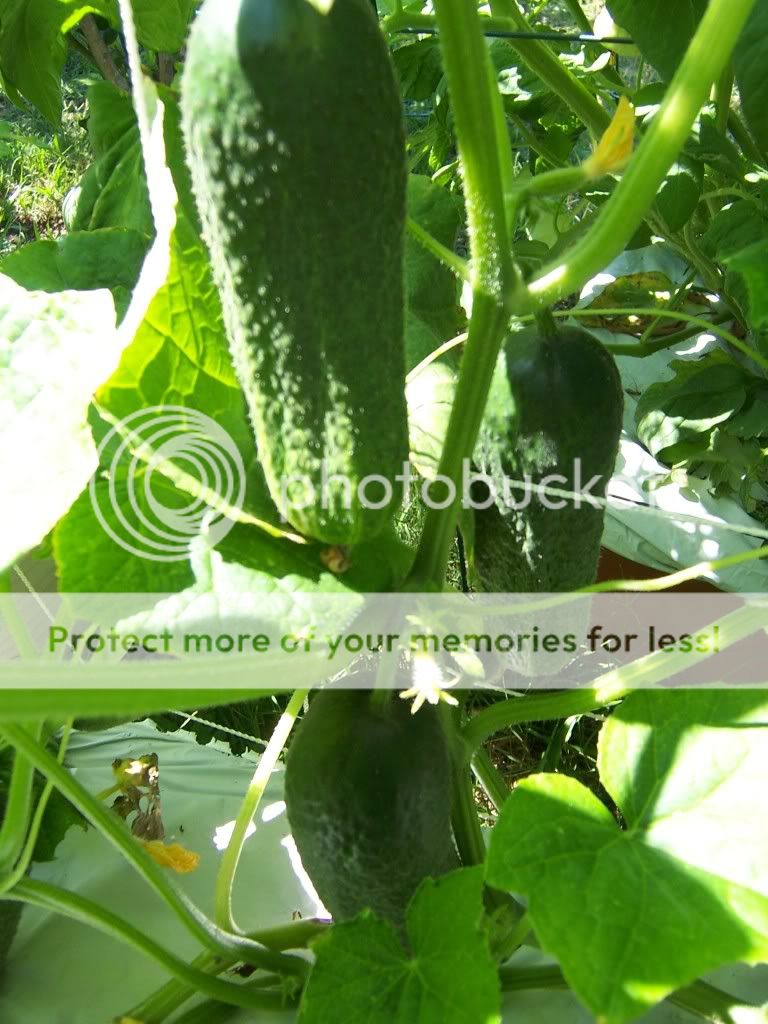
The edibles are starting to produce. I've have so many cucumbers from the Earthbox, I gave a few away. I had a few ripe cherry tomatoes, but the big ones are continuing to grow. The bugs and diseases are starting to arrive so I have to start being careful to spray regularly.

In case anyone in curious, I am spraying Bt to kill the the various caterpillars that attack tomatoes, cucumber, melons, and watermelons. When the cucumber worms arrive I may also spray a Spinosad product occasionally. I have guilt pangs whenever I use Spinosad because, although it is organic and OMRI listed, it is very bad for my friends the honey bees. I also use  the organic products Actinovate and Serenade to help with the diseases. Occasionally I also use milk (regular old diluted milk) and baking soda. In the cooler times of the year I use cooper and sulfur sprays, but it may be too hot for that now.

Monday, March 21, 2011

Yard Farm Update

Winter is over and Summer is here. Where did Spring go? It's been in the lower 80s for the last week. My warm weather garden is starting to take off and my winter garden is biting the dust. I have pulled most of the lettuce and kale, but I still have a giant cauliflower that's getting attacked by bugs. I almost pulled the cauliflower, but I did see a tiny flower head in the middle. I will let it have a chance.

The new Earthboxes are finally taking off too. Here is my most advanced box with Brandywine OTV and Goosecreek tomatoes. I am happy with the number of blooms I am seeing and the leaf coverage is way better than I usually get in my normal containers. It amazing to realize how much water these things use though.


Monday, March 7, 2011

The Yard Farm 2011

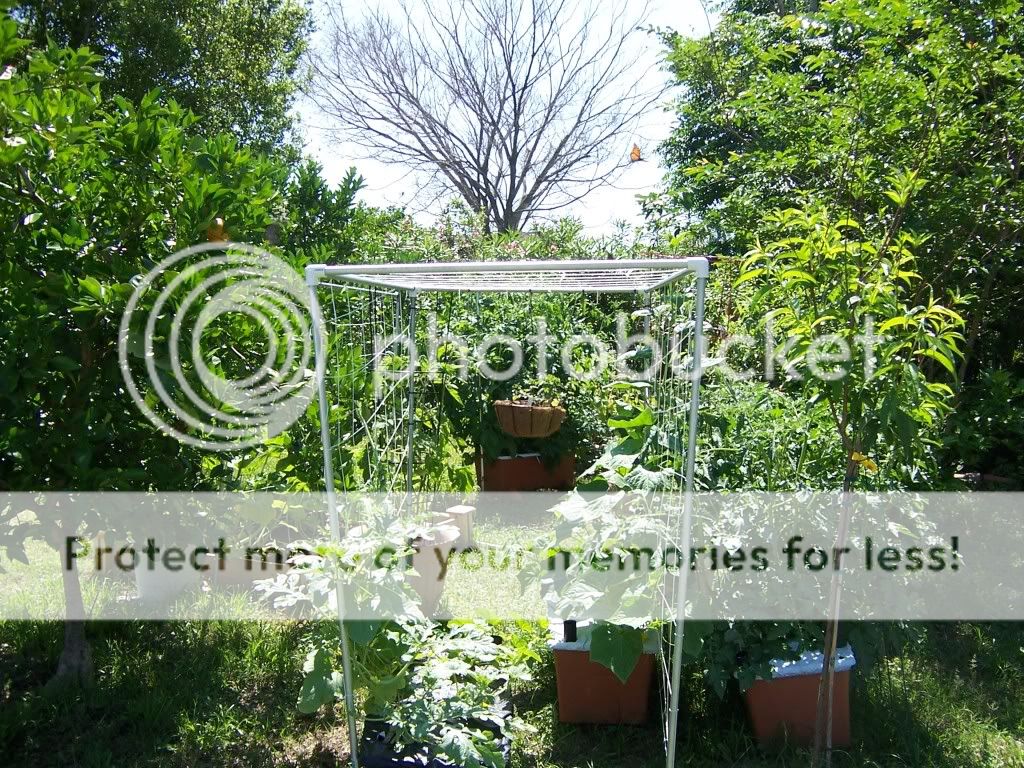
This year I have tried to learn from my failures and successes of the past. I am going to make more of an effort to trellis my vines and secure my tomato supports. I am not finished yet but you get the idea. I copied my trellis idea from the Square Foot Garden Book. I hammered rebar into the ground and slipped electrical conduit over the base. You can see I have a mixture of  two wooden raised beds, a concrete block raised bed, a few large pots, a few medium size cheapo self watering pots, and some earthboxes. Out front I also have a topsy turvy and some trees and bushes planted in the ground. We shall see how it all turns out.


Thursday, February 24, 2011

Borage in Bloom


This is a photo from my garden of a borage bloom. In all honesty the flower is much smaller than it appears in this photo. The vivid blue color is true to life though. Borage is an herb. I planted the seeds for mine in the Fall and they've survived all winter and are large plants now. The bees love them.

Apparently both the leaves and flowers are edible and taste like cucumbers. I cannot imagine anyone wanting to eat the leaves though because they are so hairy. The blooms make nice garnishes. Others have suggested candying them in sugar for decorations on desserts or freezing them in ice cubes for a touch of fanciness. I plan on trying a few of these suggestions soon.